Well Written pedigree a trip down memory lane
Dennis Ryan - Raceform • February 12th, 2026 11:59 AM • 6 min read
You know you’re getting on in years when you can recall events and personalities from more than half a century ago.
What for me is essentially a privileged position has manifested itself just lately with the emergence of Well Written as the headline act of New Zealand racing and her relationship to two of the best fillies I remember from the mid-1970s.
I refer to the half-sisters Jocasta and Porsha, one a juvenile speed machine and the other cut from quite different cloth as a Group One-winning three-year-old. They were bred and raced by Te Awamutu wine and spirits merchant Ernie Yule from his Trictrac mare Lazala, the former by Pakistan ll and the latter by Alcimedes, stallion opposites in the qualities they passed on but both belonging in the top echelon of that era.
Jocasta, who had another notable sibling in Wellington Guineas winner Dun Allen, founded her own prolific branch of the family, headed by her star sprinting grandson Bawalaksana, the winner of New Zealand’s two major 1200-metre races, the Gr.1 Railway and Telegraph.
Jocasta now features as the sixth dam of Well Written, who remained unbeaten with her runaway win in the Karaka Millions 3YO and is now the hot favourite to extend her sequence to six in the NZB Kiwi back at Ellerslie on March 7.
From her weanling purchase at A$35,000, then online resale a year later at $80,000 and now with a seven-figure value following her 50 percent purchase by Yulong Investments from her original Marsh Racing syndicate, Well Written has been the story of the season.
Matching the star filly’s name, headlines have been a familiar recurrence for her family over the decades, which takes this story back to those sixth-generation members of the damline. Jocasta and Porsha were both members of New Zealand’s dominant stable of the 1970s operated by Hall of Fame trainer Bill Sanders and his son Graeme.
The latter, retired for the past six years but still living with his wife Gael in Te Awamutu, where their daughter Debbie Sweeney continues to train winners, readily recalls the talented siblings.
“They were both lovely fillies but quite different,” Sanders told RaceForm. “The older one, Jocasta, was a real Pakistan, light on her feet and fast. Around the stables she was easy to deal with, although that changed once you saddled her up and legged a rider on, she just wanted to run.
“Porsha was quite different, big and strong with a straightforward temperament. She wasn’t anywhere near as precocious as the other filly and she showed her best form at three when she won the 1000 Guineas.”
Typical of all horses of the Sanders stable at the time, its precocious members were treated as professional racehorses and given every opportunity to show their talent. For Jocasta that meant six wins as a two-year-old, headed by the North Island Challenge Stakes, Matamata Breeders’ Stakes and Avondale Classic, all three in the second half of the 1974-75 season.
The North Island Challenge Stakes was run at weight-for-age over 1400 metres at the Trentham autumn carnival and it wasn’t uncommon for two-year-olds to contest it, carrying a featherweight under the conditions. Amongst those to win at that age were the Syd Brown-trained stablemates Weenell and Wood Court Inn in 1968 and 1969.
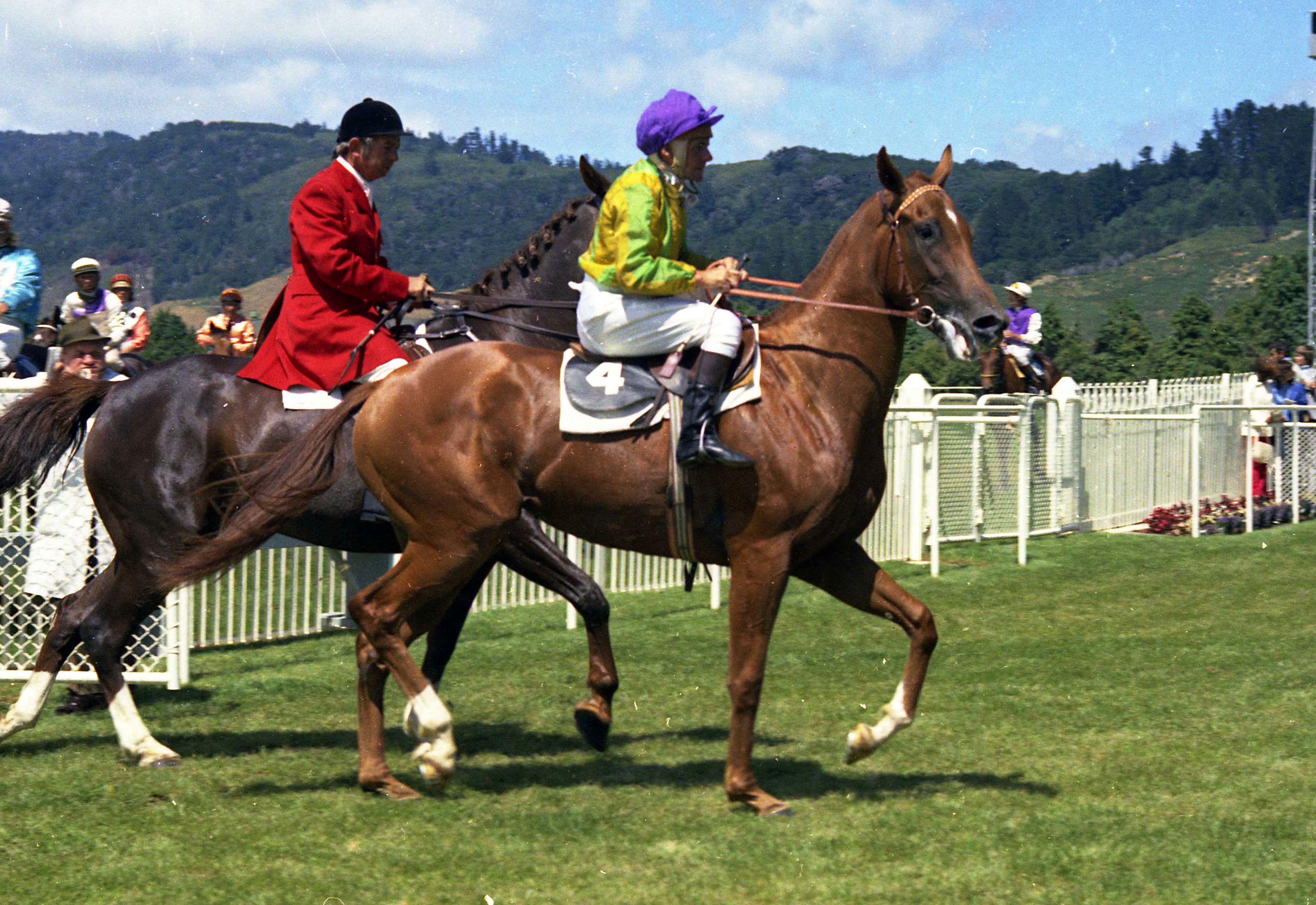
Jocasta added her name to that list when a teenaged Brent Thomson rode to her to victory in 1975, the year before New Zealand racing replaced imperial with metric measures. As the retired Hall of Fame jockey recalled while attending the recent National Yearling Sale as New Zealand Bloodstock’s Australian representative, he failed by a pound to make Jocasta’s book weight and rode her at 6 stone 9 pound (44.25kg).
That wasn’t enough to stop Jocasta from proving too fleet for her older opposition, headed by the champion weight-for-age galloper Grey Way, who was to add the North Island Challenge Stakes to his 51-win list two years later.
One of Jocasta’s non-winning two-year-old efforts at Trentham made just as big a headline, when she lined up with juvenile superiority on the line in the Wakefield Challenge Stakes. Making the pace with Des Wyatt in the saddle, everything was going to script until she lined up for the run home and inexplicably lost her bearings and jumped the running rail.
“That came out of nowhere, one stride she was travelling like a winner and the next she seemed to get lost and took on the rail,” Sanders recalled. “She didn’t actually fall and didn’t hurt herself, but Desy had no chance of staying with her.”
End-of-season ratings placed Jocasta third top filly on the Free Handicap and while she didn’t replicate that form as an older horse, she did finish fourth in the Railway Handicap.
As revealed by Arion Pedigrees, at stud Jocasta produced five winners from six to race, the best of them Sydney and Melbourne winner and Gr.3 San Domenico Stakes placegetter Princess Jocinda. She in turn was the dam of the aforementioned Bawalaksana and triple stakes winner and New Zealand Oaks placegetter Damaschino.
Her four winners included the Gr.3 VRC Thoroughbred Breeders’ Stakes winner and Gr.1 Blue Diamond Stakes runner-up Shaaheq, while further stakes winners in the pedigree are spread across New Zealand, Australia and Asia.
The damline tracing directly through those six generations and more than 50 years from Jocasta has genuine depth all the way to Well Written, even allowing that fifth dam Yoneda (by Ruling) was unraced. She made up for any racetrack deficiency by producing six winners, two of them at stakes level including Yuleda (One Pound Sterling), who then became the dam of nine winners headed by a rare stayer in the line.
That was New Kid In Town, winner of the Listed Andrew Ramsden Stakes over 3200m at Flemington, while Yuleda’s stakes-placed daughter Torolosa (Housebuster) produced the Gr.3 MRC How Now Stakes winner Valentine Miss (Danetime), the dam in turn of the stakes-placed winner Mozzie Monster (Sebring), whose only foal to race is Well Written.
The final word on the line that has produced a filly bidding for champion status belongs to Jocasta’s co-trainer Graeme Sanders.
“It always was a good breed, you only have to look at those fillies back in the day and what it’s produced during the years since,” he said. “Now to see a filly like Well Written come along and do what she’s doing – it’s great to think those old bloodlines are still able to produce a racehorse that can compete with the best.”
CLICK HERE to subscribe to RaceForm and get your copy delivered each week.